
Carport Sizes: From 12x20 to 30x40, Compared by Vehicle Fit
Updated
CarportBay tracks eight certified carport sizes, from a 240-square-foot 12x20 up to a 1,200-square-foot 30x40. The right one depends on what you are parking, not on a number you saw advertised. Use the calculator below to get a real recommendation, or jump straight to the comparison table if you already know roughly what footprint you need.
CarportBay is an independent carport buying research publisher, so the recommendation below is not shaped by which size happens to move the most inventory for a particular manufacturer. It works from the same vehicle-dimension and footprint data regardless of what you select, which is the practical benefit of comparing real options here rather than relying on a dealer or manufacturer's own sizing tool.
A manufacturer or dealer's own sizing widget has a structural incentive to steer the recommendation toward whatever it happens to have in stock or build most efficiently. CarportBay compares every manufacturer on the same footing, so the same vehicle entered twice, once here and once on a dealer site, can come back with two different answers; only one of them is built purely around fitting your vehicle.
On this page
What Size Carport Do I Need?
Pick what you are parking below and the calculator recommends a matching footprint from CarportBay's eight certified sizes, with a live diagram showing roughly how it fits inside. It covers the most common cases, a full-size truck, two vehicles side by side, an RV or camper, or a boat, and works from there. Every selection updates the recommendation immediately; there is no submit button and no form to fill out first.
Common Carport Size Recommendations by Vehicle Type
These are the calculator's own recommendations for the four most common scenarios, written out here as plain text as well as inside the tool above. A full-size truck and a pair of standard cars land on different sizes because a truck's length pushes past what a 12x20 comfortably clears with room to walk around the vehicle, while an RV or a boat moves into a different size tier entirely once its length is factored in.
Full-size truck
A 20x20 carport covers 400 square feet -- enough for one full-size pickup truck.
For 20 ft x 20 ft: Area = 20 x 20 = 400 sq ft.
Two standard cars
A 20x20 carport covers 400 square feet -- enough for two standard cars or SUVs side by side.
For 20 ft x 20 ft: Area = 20 x 20 = 400 sq ft.
Class C motorhome
A 24x30 carport covers 720 square feet -- enough for a Class C motorhome.
For 30 ft x 24 ft: Area = 30 x 24 = 720 sq ft.
Mid-size boat (16 to 26 ft)
A 24x30 carport covers 720 square feet -- enough for a 16 to 26 ft boat on its trailer.
For 30 ft x 24 ft: Area = 30 x 24 = 720 sq ft.
These four cover the most common searches, but they are starting points, not an exhaustive list. A single compact car, a double row of full-size trucks, or a boat well past 26 feet all land on a different size than the examples above, which is exactly what the calculator is for: picking the specific combination that matches your situation instead of rounding up to the nearest example.
Standard Carport Sizes Compared
CarportBay tracks eight certified sizes end to end, 12x20 through 30x40. The table below compares every one by width, length, total square footage, and the vehicle combination each size typically fits, so you can see where your own numbers land even before using the calculator above.
20x20 is the single most searched individual size in this lineup, which tracks with how often it comes up as the practical minimum for one full-size truck or two smaller cars parked side by side. 12x20 and 12x21 sit at the small end for a single standard car, while 24x30 and 30x40 are sized for a longer Class C motorhome or a fifth wheel. Comparing all eight side by side here, rather than reading about each one separately, is the faster way to see exactly where your own numbers land.
| Size | Width | Length | Square feet | Typical fit |
|---|---|---|---|---|
| 10x20 | 10 ft | 20 ft | 200 sq ft | One standard vehicle, with under 30 in of door room on each side |
| 12x20 | 12 ft | 20 ft | 240 sq ft | One standard car or small SUV |
| 12x21 | 12 ft | 21 ft | 252 sq ft | One standard car or small SUV, with extra clearance |
| 18x20 | 18 ft | 20 ft | 360 sq ft | One larger vehicle, or a single car plus storage |
| 18x30 | 18 ft | 30 ft | 540 sq ft | One RV up to about 25 to 27 ft long, with about 4.75 ft each side of an 8.5 ft body |
| 20x20 | 20 ft | 20 ft | 400 sq ft | Two standard cars side by side, or one full-size pickup truck |
| 20x25 | 20 ft | 25 ft | 500 sq ft | Two vehicles with extra length, or one shorter travel trailer |
| 24x24 | 24 ft | 24 ft | 576 sq ft | Two full-size pickups side by side, or one short Class B van with legs of 10 ft or more |
| 20x30 | 20 ft | 30 ft | 600 sq ft | Two vehicles side by side with about 14 ft of depth left behind a mid-size car |
| 30x20 | 30 ft | 20 ft | 600 sq ft | Three mid-size vehicles side by side, one vehicle deep in each bay |
| 24x30 | 24 ft | 30 ft | 720 sq ft | A longer Class C motorhome, or two vehicles plus a boat |
| 20x40 | 20 ft | 40 ft | 800 sq ft | Two vehicles across and two rows deep for vehicles up to about 18 ft long, or one motorhome that fits the length and leg-height check |
| 30x30 | 30 ft | 30 ft | 900 sq ft | Three mid-size cars side by side, or a Class B or short Class C with legs of 12 ft or more |
| 30x40 | 30 ft | 40 ft | 1200 sq ft | Three vehicles across and two rows deep for vehicles up to about 18 ft long, or one motorhome that fits the length and leg-height check |
Carport Configuration: Portable, Attached, or Freestanding
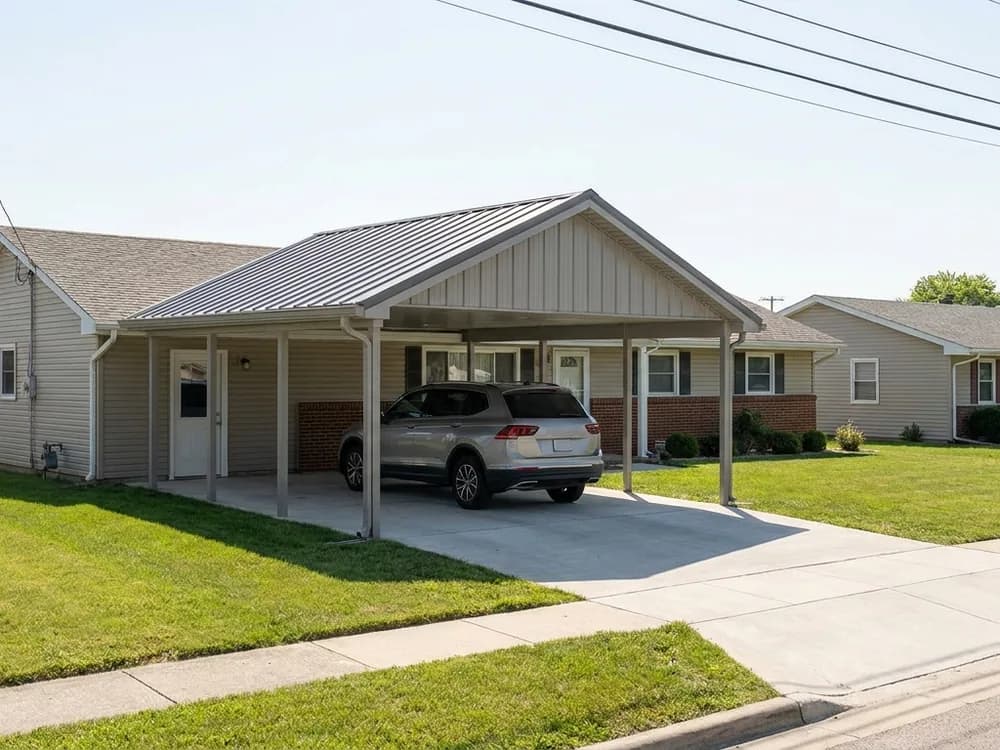
Size is one decision; configuration is a separate one. A carport can be built as a portable structure anchored to the ground, attached to an existing house or garage, or freestanding with its own posts on every side. None of the three configurations change how much square footage your vehicle needs, but they do change what the local permit office asks for and how the structure ties into whatever is already on the property, a question our installation and permits guide covers in full.
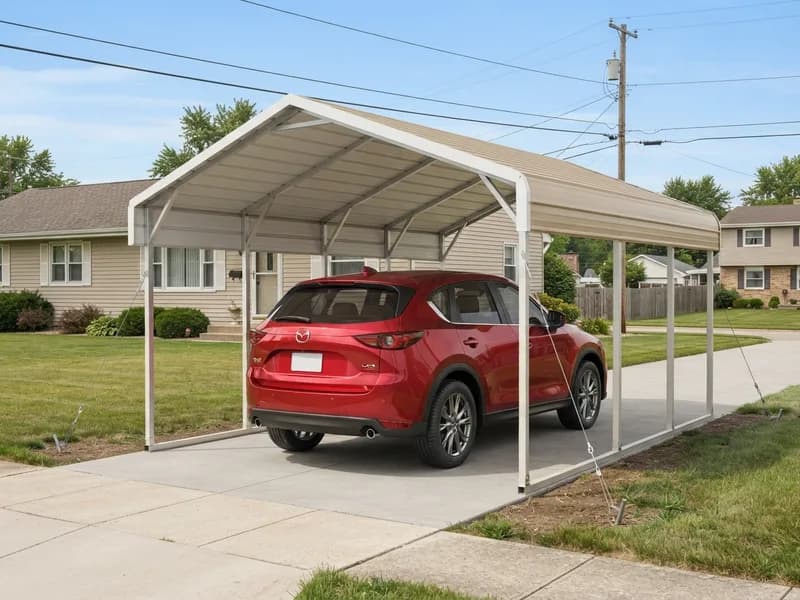
Portable
Freestanding and anchored to the ground rather than a structure, built to be relocated if needed. The most common configuration for a stand-alone parking cover.
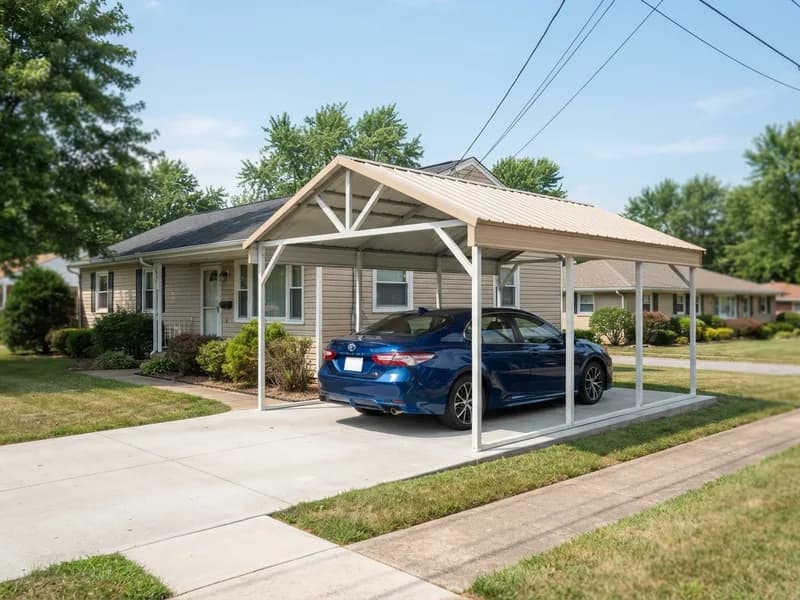
Attached
Built onto the side of an existing house or garage, sharing one wall or roofline with the structure it's attached to. Often needs a different permit review than a stand-alone structure.
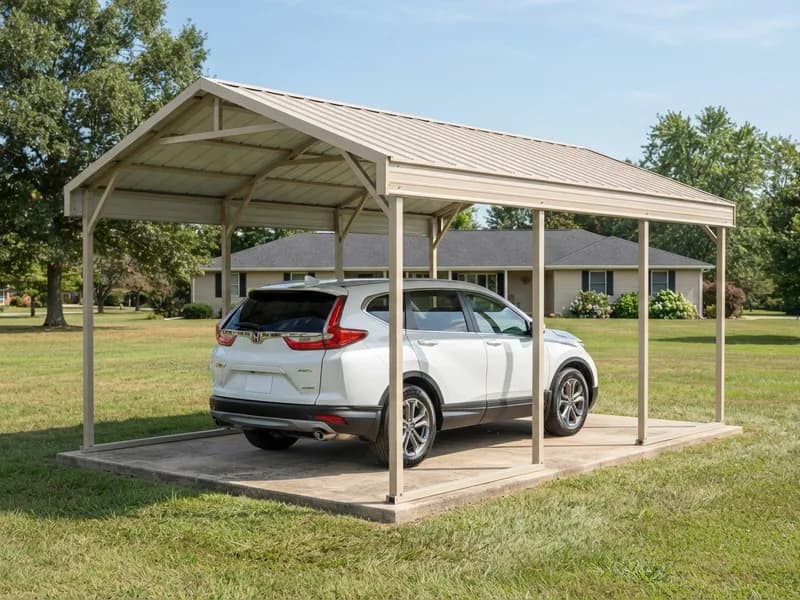
Freestanding
A fully independent structure with its own posts and roof on all sides, set apart from any other building. The typical choice when there's open yard or driveway space to work with.
Most homeowners default to portable or freestanding, since both skip the structural tie-in an attached carport needs with the existing roofline. Attached can work out cheaper in material terms, since it borrows one wall or roof edge from the house or garage, but that shared structure is also why some jurisdictions review it under different rules than a stand-alone building.
Portable and freestanding differ mainly in how permanent the installation is. Portable units are typically anchored with ground stakes or helical anchors and can, within limits, be relocated if a property changes, while a freestanding structure is set on its own permanent footings the same way a detached garage would be. Neither choice changes the square footage recommendation above; both can be built at any of the eight certified sizes.
Carport Capacity by Vehicle Type
Underneath every size recommendation is a real vehicle length. CarportBay checked average and class-based dimensions for each capacity category below so the calculator's recommendations trace back to real figures rather than a round number chosen for convenience.
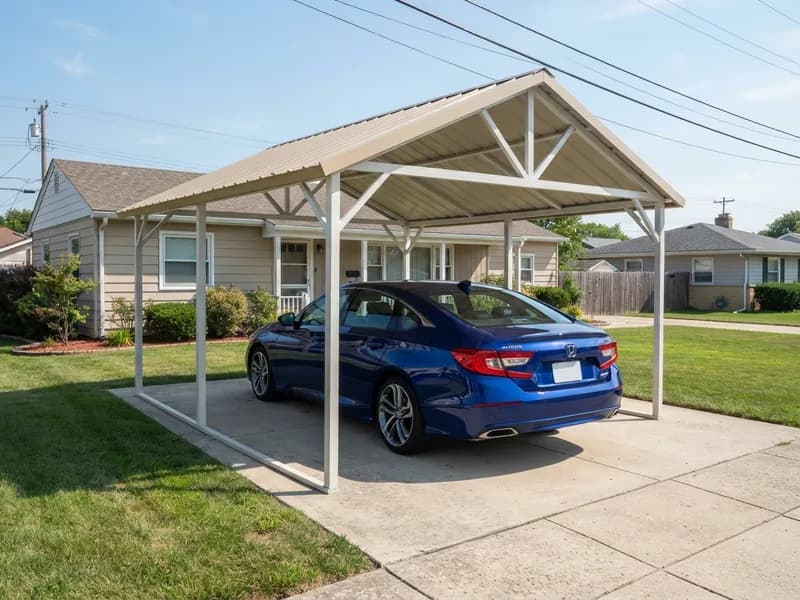
Single car
One standard car or SUV
about 14.8 to 15.2 ft long
- Standard car or SUV → 12x20
- Full-size pickup truck → 20x20
Source: Cartelligent, average mid-size car and SUV length. Last verified 2026-10-04.
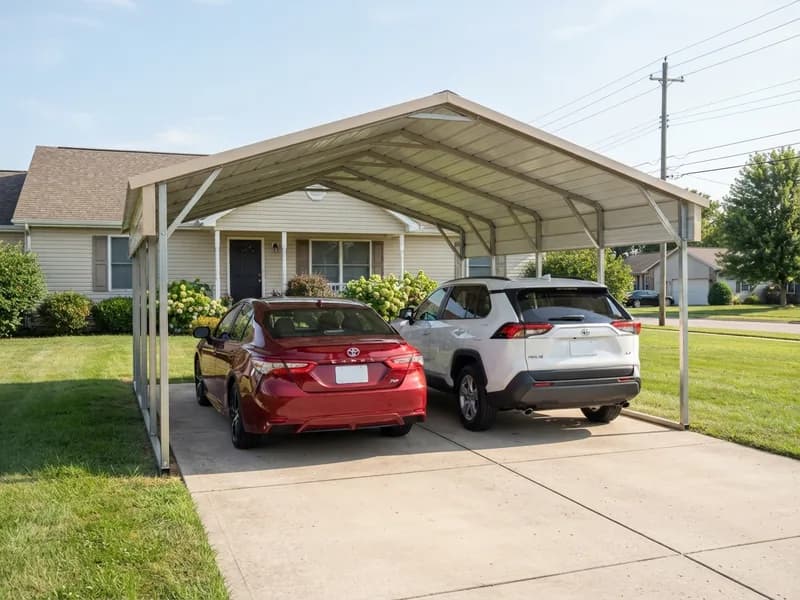
Two vehicles
Two cars, SUVs, or trucks parked side by side
each vehicle about 14.8 to 18.4 ft long
- Two standard cars or SUVs → 20x20
- Two full-size trucks → 24x24
Source: Cartelligent, average mid-size car/SUV and full-size pickup truck length. Last verified 2026-10-04.
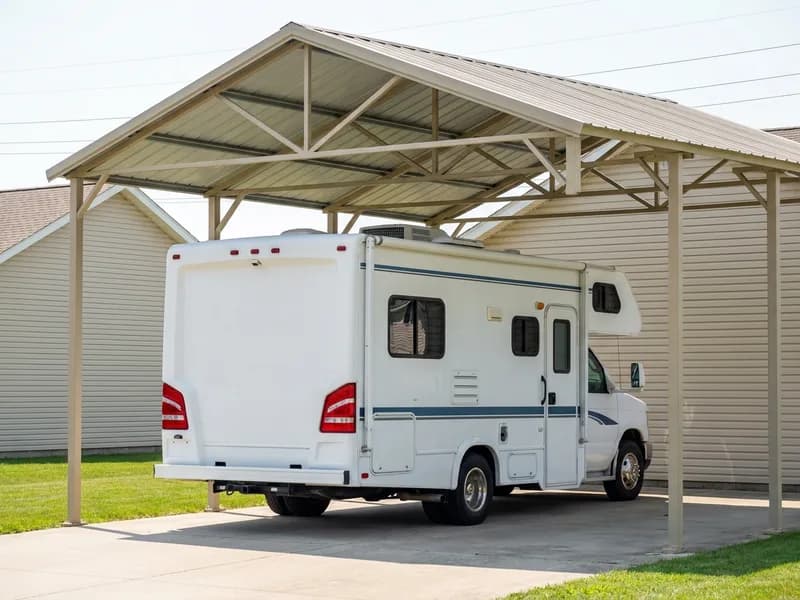
RV or camper
A motorhome, travel trailer, or fifth wheel
17 to 45 ft long depending on class
- Class B camper van (17-23 ft) → 24x24
- Class C motorhome (20-33 ft) → 24x30
- Class A motorhome or fifth wheel (26-45 ft) → 30x40
Source: Storage.com RV dimensions guide, by RV class. Last verified 2026-10-04.
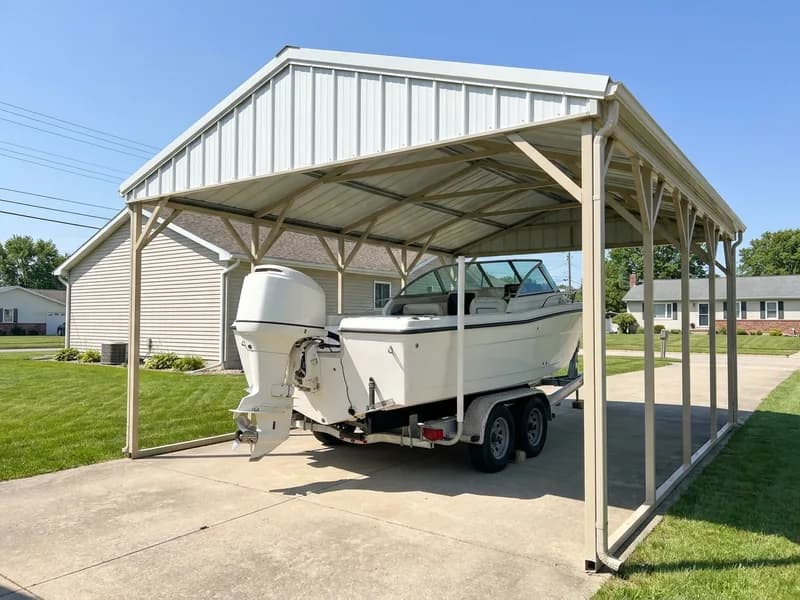
Boat
A boat on its trailer
under 16 ft to 26 ft and up, by USCG length class
- Under 16 ft (jon boat, small fishing boat) → 12x20
- 16 to 26 ft (bowrider, pontoon, center console) → 24x30
- Over 26 ft → 30x40
Source: AceBoater boat size classification by length. Last verified 2026-10-04.
RV and camper is the largest capacity segment by search volume of the four, and it is also the category with the widest length spread, 17 feet for a compact Class B van up to 45 feet for a large Class A motorhome or fifth wheel. That spread is exactly why RV buyers benefit most from checking the exact class rather than assuming "RV size" means one footprint. Boat trailers follow a similar pattern: a small jon boat under 16 feet fits the smallest certified size, while a center console or pontoon in the 16 to 26 foot range, the single most common range for boats in North America, needs a meaningfully larger footprint.
How These Size Recommendations Are Checked
The eight certified sizes above come from CarportBay's own tracked topical map, not a single manufacturer's catalog, which is why they read as round, industry-standard dimensions rather than one brand's product-line names. The vehicle length ranges behind each capacity category (the section above) are checked against named third-party sources rather than written from memory: average car and SUV lengths from automotive-data provider Cartelligent, RV class dimensions from Storage.com's RV sizing guide, and boat length classes from AceBoater's boat classification reference, which itself follows the standard length-class system used across the recreational boating industry.
None of these figures are exact for every vehicle built to that classification; trim levels, aftermarket modifications, and manufacturer variation all move the real number by a foot or two in either direction. Treat the calculator's recommendation as a confident starting point built on real industry data, then confirm it against your specific vehicle's actual measurements before ordering.
CarportBay revisits these length ranges on the same semi-evergreen schedule it applies to the rest of the sizing content: rechecked at each content refresh rather than left to go stale indefinitely, since average vehicle dimensions do shift over time as manufacturers redesign model lines.
How Much Clearance Height Does a Carport Need for an RV?
Most Class B camper vans clear a standard 7-foot carport post height without issue, but a Class A motorhome or a fifth wheel can run 12 to 13.5 feet tall before adding anything mounted on the roof, like an air conditioning unit or a satellite dome. Travel trailers and fifth wheels also carry a hitch tongue that adds another 2 to 4 feet to the overall length a carport needs to clear, on top of the body length itself. Measure the vehicle's actual height, roof-mounted equipment included, rather than relying on the manufacturer's published figure alone, and build in a safety margin above it.
Post height is a separate decision from footprint size, and it is worth confirming before ordering if the vehicle is anywhere near 10 feet tall or more. Most manufacturers offer a choice of standard leg heights, and picking a taller one does not change the square footage the calculator above recommends, since height and footprint are sized independently.
Boats need the same check from a different angle: a center console or pontoon with a T-top, tower, or radar arch can add several feet of height once it is sitting on its trailer, even though the hull itself sits low. Measure to the top of whatever is tallest on the boat and trailer combined, not the hull alone, before assuming a standard leg height will clear it.
What Size Carport Requires a Permit?
There is no single size that always needs a permit and none that never does. Most building departments set the threshold by total square footage or by height rather than by a specific carport dimension, and the exact number varies by city and county, some places require a permit above 120 square feet, others only above 200 or more. Configuration matters too: an attached carport is commonly reviewed differently than a freestanding one, even at the same size.
A homeowners association can also set its own approval process on top of whatever the city or county requires, independent of square footage entirely. None of this changes what size actually fits your vehicle, but it does affect how long the project takes from decision to installed structure. Check with the local permit office and, where one applies, the HOA, before finalizing a size, and see our local permit requirements guide for what that review usually covers.
Carport Size vs. Price: How Much Does Size Change Cost?
Square footage is one of the biggest cost drivers in a carport quote. Moving from a 12x20 up to a 20x20 roughly doubles the covered area, and material, roof style, and the manufacturer you buy from move the price from there. A larger footprint also typically means heavier-gauge steel or additional support posts to carry the extra roof span, which adds cost beyond the simple area increase.
CarportBay does not publish a single price list, since manufacturer pricing changes often and varies by region, and quoting a specific figure here would go stale quickly. Two buyers ordering the same 20x20 steel carport in different states, from different manufacturers, can see meaningfully different quotes once delivery distance and local labor rates for installation are factored in. Once you know your size, compare real manufacturer kits, independently, to see how the same footprint prices out across different suppliers before you commit.
Share your ZIP code and project details, and we match you with installers and manufacturers that serve your area.
Frequently Asked Questions About Carport Sizing
What size carport do I need for a double-wide truck?
A 20x20 carport (400 square feet) is the starting point for a single full-size pickup truck, and it is also the minimum CarportBay recommends when a truck needs real clearance on both sides rather than a tight fit. Two full-size trucks parked side by side need a 24x24 (576 square feet) instead, which gives each truck room to open its doors without the carport feeling cramped.
Can a carport be extended or resized after installation?
Many carport structures can be lengthened by adding bays, but doing so after installation usually costs more per square foot than ordering the larger size from the start, and it may trigger a new permit review since the structure’s footprint is changing. If there is any chance a second vehicle or a larger RV joins the household later, sizing up at the time of purchase is typically the simpler and cheaper path over the life of the structure.
What is the minimum carport size for local code compliance?
There is no single national minimum: permit thresholds are set by city and county building departments and are usually based on square footage or height rather than a fixed minimum size. Confirm the exact threshold with the local permit office before finalizing a size.
Do I need extra clearance beyond my vehicle’s exact length?
Yes. The 8 certified CarportBay sizes already build in working room beyond a bare vehicle measurement, but that margin assumes a reasonably straight pull-in. If you need to walk around the vehicle, open doors or a tailgate fully, or store anything else alongside it, size up rather than cutting it to the vehicle’s exact footprint.
Can one carport fit both a car and an RV at different times?
Yes, as long as it is sized to the larger of the two vehicles. Pick the capacity option for whichever vehicle has the longer footprint, since a size that fits an RV will also fit a smaller car, but the reverse is not true.
Related: Carport Accessories and Local Sizing Norms
Two topics sit outside sizing itself but come up often enough once a size is settled that they are worth a direct link rather than a passing mention.
Local and regional sizing norms
Snow load, wind zone, and lot-size norms can shift the right size by region.
Once you have a size in mind, the next practical step is material: steel, wood, and aluminum carports perform differently under the same footprint, and roof style affects both wind rating and price. Compare metal, wood, and aluminum carports to keep narrowing down your choice, or go straight to CarportBay's side-by-side comparison tool once you have a shortlist of specific manufacturer kits to weigh against each other.
Ready to move forward
Get Matched With Installers Near You
Tell us a bit about your project and we will connect you with vetted installers and manufacturers who serve your area. There is no cost or obligation to request information.
See the affiliate disclosure page for how referrals work.
More sizing guides
- dimension carport guideHow to read width, length and height.
- two car carport size to buyWhich width and depth to buy for two vehicles.
- 12x12 carport fit and costWhat fits, what it costs and permit rules.
- 30x25x9 triple wide lean-to carportFootprint, fit and listing prices.