
Carports: A Buying and Building Guide to Size, Material and Permits
CarportBay Editorial Team Reviewed
A carport is a roofed, often open-sided structure that shelters a vehicle, RV, or boat, and common residential sizes run from 12x20 (240 sq ft) to 30x40 (1,200 sq ft). Permit rules depend on your city: the 2021 IRC exempts one-story detached accessory structures up to 200 sq ft, but San Antonio requires a permit to build a carport.
Five decisions shape every carport purchase: size, material, cost, permits and who sells. Each section gives you the overview, then points to the page that covers the topic in depth. Read top to bottom for the full picture, or jump to the section that matches your question.
CarportBay builds no carports, so you get comparisons based on fit and local rules, not one company's catalog.

On this page
What a carport is and the main kinds
A carport is a roofed structure, usually open on at least one side, that shelters a vehicle, RV or boat from sun, rain and snow.
For the full definition and the terms used around it, see the answer to what is a carport.
Carports come in three configurations. Configuration describes how the structure sits on your property.
- Portable
- Anchored to the ground rather than to another structure, and built to be relocated if needed.
- Attached
- Built onto the side of a house or garage, sharing one wall or roofline with it. An attached carport often needs a different permit review than a stand-alone one.
- Freestanding
- A fully independent structure with its own posts and roof, set apart from any other building.
Capacity describes what the carport shelters. It falls into four tiers.
- Single-car
- One standard car or SUV.
- Two-car
- Two cars, SUVs or trucks parked side by side.
- RV
- A motorhome, travel trailer or fifth wheel.
- Boat
- A boat on its trailer.
Configuration and capacity are ways to filter carports, not separate kinds of carport. You can pick any configuration at any capacity. Start with configuration when your lot is the limit, and start with capacity when your vehicle is the limit.
How big carports are
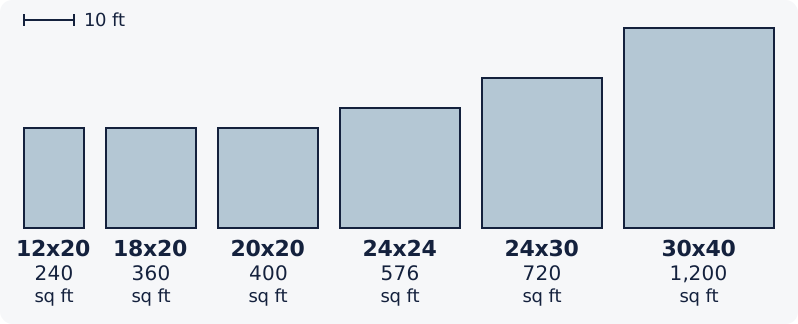
Common carport sizes run from 12x20 (240 sq ft) to 30x40 (1,200 sq ft), and the footprint in square feet decides which vehicles fit.
| Size | Width x length | Square feet |
|---|---|---|
| 12x20 | 12 x 20 ft | 240 sq ft |
| 18x20 | 18 x 20 ft | 360 sq ft |
| 20x20 | 20 x 20 ft | 400 sq ft |
| 24x24 | 24 x 24 ft | 576 sq ft |
| 24x30 | 24 x 30 ft | 720 sq ft |
| 30x40 | 30 x 40 ft | 1,200 sq ft |
Each square footage is the width multiplied by the length. The largest footprint here has five times the floor area of the smallest.
A 12x20 suits one standard car or small SUV. A 20x20 holds two standard cars side by side, or one full-size pickup truck. A 24x24 fits two full-size trucks, or one mid-length Class B or C RV (recreational vehicle). Measure the longest vehicle you own, then add working room for doors, tailgates and ladders.
Larger footprints serve larger needs. An 18x20 suits one larger vehicle, or a single car plus storage. A 24x30 fits a longer Class C motorhome, or two vehicles plus a boat. A 30x40 holds a large Class A motorhome or fifth wheel, or three or more vehicles.
Measure the parking area before you pick a footprint. Note the slope of the ground and the position of fences, trees and the house, and check the vehicle's height against the carport's clearance.
Once you know the footprint you need, see choosing a carport size for the vehicles you park.
The diagram below draws all six footprints to one scale, so you can compare them by eye. The table above is its text version.
It recommends a size from your vehicle type and count, with no manufacturer behind the answer.
Materials and roof styles
Carports are built from steel, wood or aluminum and come in four roof styles: regular, A-frame, boxed eave and vertical.
A steel carport uses a steel frame and steel roof panels. Ask any quote to state the steel thickness and coating it assumes. An aluminum carport uses an aluminum frame and aluminum roof panels, so ask for its thickness and finish. A wood carport uses timber for the posts and framing, so ask for the wood species and treatment. A quote that names the material but not these details leaves a gap you should close before you compare prices.
A regular roof has rounded edges, and its panels run horizontally across the structure. An A-frame roof has sides that meet at a peak, like the letter A. A boxed eave roof has straight sides like a house roofline, with boxed trim along the eaves. A vertical roof runs its panels from the ridge, the peak line along the top, down to the eaves.
Material and roof style are separate choices, so compare them together before you decide.
Manufacturers use these names in slightly different ways, so check the drawing on any quote. For the side-by-side detail, see how steel, wood and aluminum options differ.
Does a carport need engineering certification?
That depends on where you build. Engineering certification means an engineer's drawings show that a carport meets the wind and snow loads set by a named code edition. The 2024 International Building Code (IBC) references ASCE 7-22, the standard that sets design loads for wind and snow, and the edition your state or city enforces can differ. Ask your building department which edition applies before you request certified drawings.
What a carport costs and what drives it
Carport cost depends on size, material, roof style, certification, site preparation, permits, delivery and installation.
Size sets how much material the structure needs. Material and roof style change the parts and the labor. Cost drivers overlap, so a change in one, such as size, often changes another, such as delivery. Certification adds engineering paperwork for local wind and snow loads. Site preparation covers the condition of the ground the carport stands on.
Permits add a fee set by your city. Delivery and installation add the cost of getting the structure to your site and assembling it. Ask every quote to list which of these eight items it includes, because totals only compare when the scope matches. Ask for the quote in writing, with each line item named, so you can compare two offers fairly. Delivery and site preparation are worth asking about first, because quotes can handle them differently.
This page prints no prices. For kit prices and manufacturer details, use the buying guide.
Is it cheaper to buy a carport or build one?
The answer depends on the same cost factors, plus the value of your own labor. Compare the full cost of each route, from materials to permits, before you decide.
How much does a carport cost to install?
Installation is priced by site, size and local labor, so no single national figure applies. Ask for an installed total that includes delivery, site preparation and any permit fee. The next section shows where local permit rules enter that total.
Share your ZIP code and project details, and we match you with installers and manufacturers that serve your area.
Permit rules and code editions
Whether a carport needs a permit depends on your city and county, and the code edition your jurisdiction has adopted.
Model codes, such as the International Residential Code (IRC) from the International Code Council (ICC), set a starting point. Your city or state adopts an edition and may add its own rules. Three examples show how much the answer varies.
| Jurisdiction | Rule | Code or document |
|---|---|---|
| Model code (IRC) | Exempt up to 200 sq ft | 2021 IRC R105.2 |
| California | Exempt up to 120 sq ft | CRC Section 105.2 |
| San Antonio, Texas | Permit required | Carports Fact Sheet, 2024 |
The IRC exemption covers one-story detached accessory structures up to 200 sq ft of floor area. California's rule, in the California Residential Code (CRC), uses 120 sq ft. San Antonio's fact sheet, dated January 25, 2024, lists a $160 online or $170 in-person permit fee. It also sets a front setback of 10 ft in most residential districts, a side setback of 3 ft and a depth of 20 ft.
Last verified:
Permit rules, fees and the code edition that applies change from city to city, so check permit rules, code editions and fees by city before you order.
Do you need a permit for a carport?
It depends on your jurisdiction. In the examples above, one sets a 200 sq ft exemption, one sets 120 sq ft and one requires a permit outright. Call your local building department with your footprint, your height and whether the carport attaches to a house. Ask about setbacks and whether a homeowners association has its own rules.
Does a 20x20 carport need a permit?
A 20x20 footprint is 400 sq ft, larger than both the 200 sq ft IRC figure and the 120 sq ft California figure. San Antonio requires a permit for any carport. Codes can measure area in different ways, such as floor area or roof projection, so confirm the method with your local building department.
Who makes and who sells carports
Carports are made by manufacturers, and sold through dealers or directly by the maker.

In the sales chain, a manufacturer makes the carport, a dealer may resell it and you buy it.
The company that makes your carport, the one that quotes it and the one that installs it can be three different businesses. Ask each company in writing who delivers, who installs and who answers warranty questions.
A name on a quote does not tell you whether the company is the maker or a dealer. Confirm the role before you compare two prices. Buying direct from a manufacturer and buying through a dealer can both work. What matters is knowing which one you are dealing with, and getting the scope, delivery date and warranty terms in writing. Before you sign, ask five questions: who makes the structure, who sells it, who installs it, who handles permits and who stands behind the warranty.
CarportBay tracks 10 manufacturers. The list below is not a ranking and follows no preference.
- Carolina Carports
- Eagle Carports
- American Steel Carports
- ACE Steel
- US-Steel Buildings
- VersaTube
- American Metal Buildings
- Elite Metal Structures
- Canopia by Palram
- Alan's Factory Outlet
You can read how the roles differ without one company's pitch attached. To see the difference in practice, read how carports are sold, manufacturer versus dealer.
Where to start
Start with the decision that blocks you today: size, material, buying, permits or comparison. Match your next question to a row below, then open that guide. If two rows fit, take the earlier one, because each decision builds on the one before.
- 5topic guides
- 10manufacturers tracked
- 14sizes in the data
| If you need to | Start here |
|---|---|
| Pick a size that fits | Sizing & Configuration |
| Choose a material or roof | Material & Roof Style |
| Understand kits and manufacturers | Buying Guide & Kits |
| Learn what permits require | Installation, Permits & Certification |
| Compare my shortlist | Comparison |
Sizing & Configuration
Match a footprint to your vehicle, RV or boat, and see how configuration changes the choice.
See how carports are sized for your vehicle
Material & Roof Style
Compare steel, wood and aluminum, and the four roof styles, side by side.
Compare metal, wood, and aluminum carports
Buying Guide & Kits
See how the manufacturers CarportBay tracks differ, and how a manufacturer differs from a dealer.
Compare real manufacturer kits, independently
Installation, Permits & Certification
Find out how permit rules, code editions and installation vary by city.
Check permit rules for your area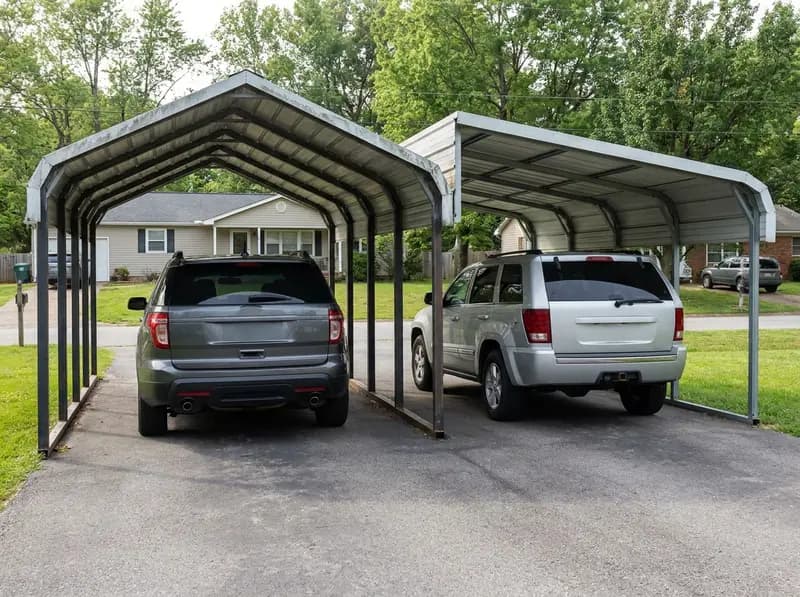
Comparison
Put your shortlist side by side on the attributes that decide the purchase.
See carports compared side by sideWhat this guide does not cover
This guide stays at overview depth and sends each topic to the page that owns it.
It leaves out kit prices, manufacturer-by-manufacturer comparison, city-level code detail, how-to build steps, and shelters for RVs and boats. Each of those belongs in a dedicated guide, so it can carry the depth an overview cannot. Kit prices and manufacturer details sit with the buying guide, and permit and code detail by city sits with the permits guide.
Accessories and parts, rental, local city pages and financing are also outside its scope.
If you are unsure where to begin, start with size, because material, cost and permits all build on the footprint you choose.
Ready to move forward
Get Matched With Installers Near You
Tell us a bit about your project and we will connect you with vetted installers and manufacturers who serve your area. There is no cost or obligation to request information.
See the affiliate disclosure page for how referrals work.