
Aluminum Carports: Frame Specs, Ratings and 2026 Prices
CarportBay Editorial Team Reviewed
Last verified:
An aluminum carport (also spelled aluminium) uses a frame metal that weighs about one-third as much as steel and is about one-third as stiff. Listings checked on 5 October 2026 ran from about $650 to $11,148 by build type. Five checks show whether a listing's numbers hold up: wind rating, snow load, alloy, wall thickness and fasteners.
| Property | Aluminum | Steel |
|---|---|---|
| Weight | About one-third of steel | Baseline |
| Stiffness | About 70 GPa | About 200 GPa |
| Same-section bending | About 3 times as much | Baseline |
| Rust | No rust. Chlorides corrode it | Depends on the coating |
On this page
What is an aluminum carport?
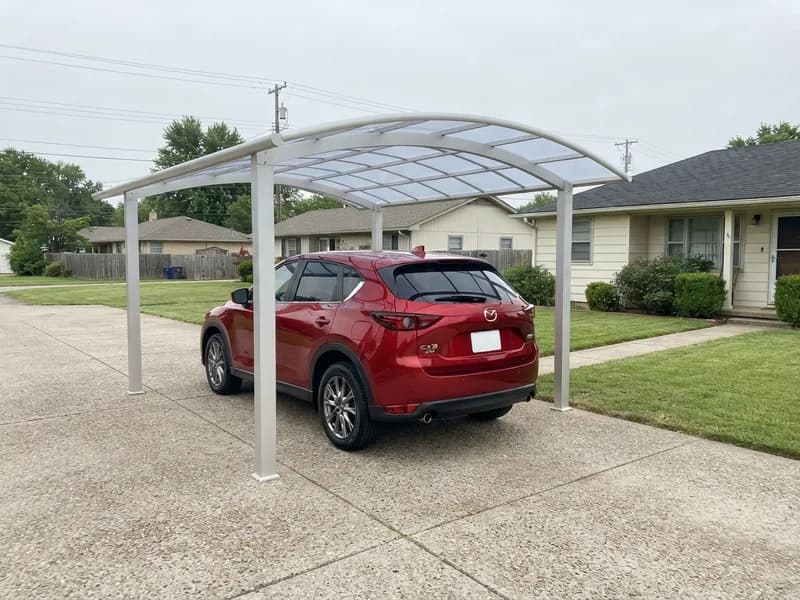
An aluminum carport is a roofed vehicle shelter whose frame is made of aluminum, spelled aluminium outside the US and Canada. Most are open on the sides and stand on posts anchored to a slab or footings. The frame is usually extruded, which means shaped bars pushed through a die, and the roof is a separate panel such as polycarbonate, a flat pan or a corrugated sheet.
Canopia by Palram, a kit maker, describes its carports as a "heavy-duty aluminum frame and incredibly resilient polycarbonate panels" (Canopia, checked 5 October 2026). This page covers residential carports, kits and patio-cover style systems. Commercial and architectural aluminum buildings are a different product.
How does aluminum compare with steel?
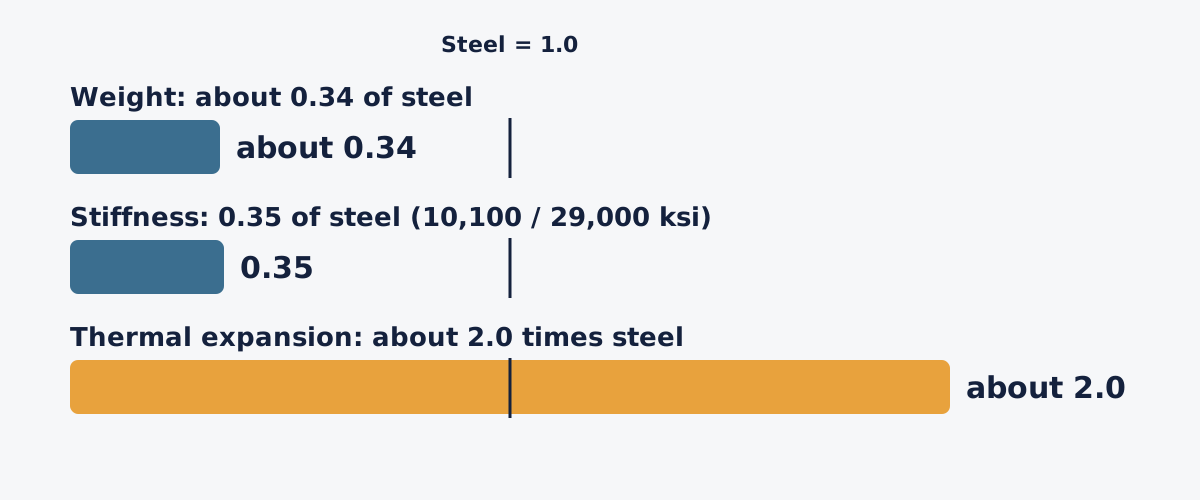
Aluminum weighs about one-third as much as steel and is about one-third as stiff, so an aluminum section bends about three times as far under the same load. Steel has a modulus of 29,000 ksi and aluminum 10,100 ksi. Strength is a separate measure that depends on the alloy, temper and section, not on the word aluminum. Aluminum also expands about twice as much as steel for each degree, so long runs need room to move at the joints.
Steel's gauge and coating figures are on the metal carports compared by gauge and coating page.
| Property | Aluminum | Steel | Source |
|---|---|---|---|
| Density | 2.70 g/cm³ (0.098 lb/in³), about one-third of steel | About three times as heavy per volume | Aluminum Design Manual; University of Florida materials page |
| Stiffness (Young's modulus) | About 70 GPa (10,100 ksi) | 200 GPa (29,000 ksi) | Aluminum Design Manual; AISC Manual, 14th ed. |
| Bending under the same load, same section | 29,000 / 10,100 = 2.9, so about 3 times as much | 1 (baseline) | Calculated from the two moduli |
| Minimum yield strength (extrusions) | 6063-T5: 16 ksi (110 MPa). 6063-T6: 25 ksi (172 MPa). 6061-T6: 35 ksi (241 MPa) | Depends on the grade | ILSCO Extrusions, minimum values |
| Thermal expansion (10⁻⁶ per °F) | 13 | 6.5 | Aluminum Design Manual; AISC Manual, 14th ed. |
| Corrosion | No rust. An oxide film protects it, and chlorides or contact with other metals can break it down | Depends on the coating | Aluminum Association |
| Measure | Aluminum against steel |
|---|---|
| Weight | About 0.34 of steel |
| Stiffness | 0.35 of steel (10,100 / 29,000 ksi) |
| Thermal expansion | About 2.0 times steel |
What are the five checks for an aluminum carport listing?
Five numbers on a listing show whether an aluminum carport's ratings can be trusted: wind rating, snow load, alloy and temper, wall thickness and fastener metals. A listing that states all five can be compared line by line. One that states none is a price only.
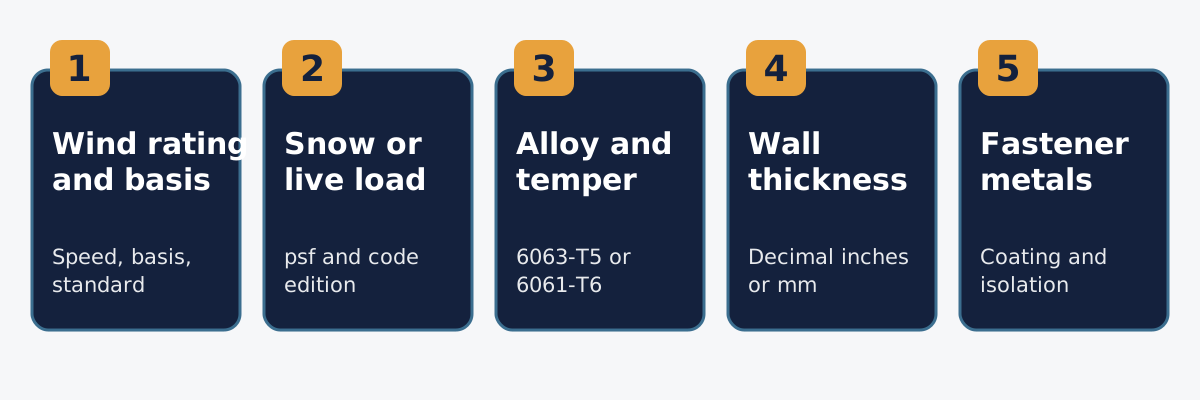
- Wind rating and its basis
- Snow or live load and its code edition
- Alloy and temper
- Wall thickness
- Fastener metals and the coast
| Check | What a good listing states | Why it matters |
|---|---|---|
| 1 Wind rating and basis | Speed in mph, ultimate or nominal, and the standard | A bare "75 mph" cannot be set against a design wind speed without its basis |
| 2 Snow or live load | Load in psf and the code edition | ScreenHouse names the 2011 IBC. The Arizona Wave listing names no standard |
| 3 Alloy and temper | Alloy number and temper, such as 6063-T5 | Minimum yield runs from 16 ksi to 35 ksi across common alloys and tempers |
| 4 Wall thickness | Thickness in decimal inches or millimeters | A steel gauge number does not give an aluminum thickness |
| 5 Fastener metals | Fastener material, coating and isolated joints | Uncoated steel fasteners in a wet aluminum joint set up galvanic corrosion, and coastal air speeds it |
Check 1: What wind rating does it state, and on what basis?
A wind rating is only useful with its speed, its basis (ultimate or nominal) and the standard it was tested to, and most listings give none of the three. ScreenHouse states wind ratings of "90 mph and over" and ties its load figures to wind exposure B and an importance factor of 1 (ScreenHouse, checked 5 October 2026). The Arizona Wave 10x16 listing at ShedsDirect gives a 75 mph wind load and names no standard (ShedsDirect, checked 5 October 2026).
Check 2: What snow or live load does it state?
A snow or live load rating needs a figure in psf (pounds per square foot) and the code edition it follows, and ScreenHouse states 20, 30 and 40 psf per the 2011 IBC. The Arizona Wave listing states 15.4 psf with no standard. The design snow load for an address comes from the local building department.
Check 3: Which alloy and temper is the frame?
Minimum yield strength differs by more than 2 to 1 between common aluminum alloys and tempers. An alloy is a metal mixed with other elements, and a temper is the heat treatment that sets strength, such as T5 or T6. Minimum yield, the stress at which the metal starts to deform for good, is 16 ksi for 6063-T5, 25 ksi for 6063-T6 and 35 ksi for 6061-T6 (ILSCO Extrusions, minimum values). Of the 14 seller and guide pages read on 5 October 2026, none names an alloy or a temper.
Check 4: How thick are the walls?
Wall thickness is stated in decimal inches or millimeters, as on ScreenHouse's .024 and .030 in. flat pan, not as a steel gauge number. ScreenHouse lists .019, .025 and .032 in. for its W pan. Ask for the thickness in inches, because a steel gauge number does not give an aluminum thickness.
Check 5: What metal are the fasteners, and how near is the coast?
Uncoated steel fasteners in a wet aluminum joint cause galvanic corrosion unless the two metals are isolated, and coastal air speeds the damage. The Aluminum Association's design guidance calls for the other metal to be painted or coated where it touches aluminum in a wet joint, with 300-series stainless steel, zinc and cadmium as exceptions. Chlorides in coastal air and road salt also break down aluminum's protective oxide film, so ask what the fasteners are made of.
How do a listing's ratings compare with design wind and snow in your state?
A listing's 75 mph rating cannot be set against the 90 mph design wind speed for inland Texas until the seller states the basis of the 75. A rating is a seller's stated figure, and a design value is a code figure for a place. The table shows them side by side without converting either.
| Row | Figure | Basis stated | Source |
|---|---|---|---|
| Palram Arizona Wave 10x16 listing: wind | 75 mph | Not stated. No standard named | ShedsDirect listing, checked 5 October 2026 |
| Palram Arizona Wave 10x16 listing: snow | 15.4 psf | Not stated. No standard named | ShedsDirect listing, checked 5 October 2026 |
| ScreenHouse: wind | "90 mph and over" | Exposure B and importance factor 1. Ultimate or nominal not stated | ScreenHouse, checked 5 October 2026 |
| ScreenHouse: live load | 20, 30 and 40 psf | 2011 IBC | ScreenHouse, checked 5 October 2026 |
| Design wind, Texas inland and Panhandle | 90 mph | ASCE 7-16 | CarportBay wind table, 3 October 2026 |
| Design wind, Texas coastal | Up to 180 mph | ASCE 7-16 | CarportBay wind table, 3 October 2026 |
| Design wind, Kansas major jurisdictions | 105–120 mph | ASCE 7-16 | CarportBay wind table, 3 October 2026 |
Ask the seller for the speed, the basis and the standard, and ask your building department for the design values at your address.
What do aluminum carports cost by build type?
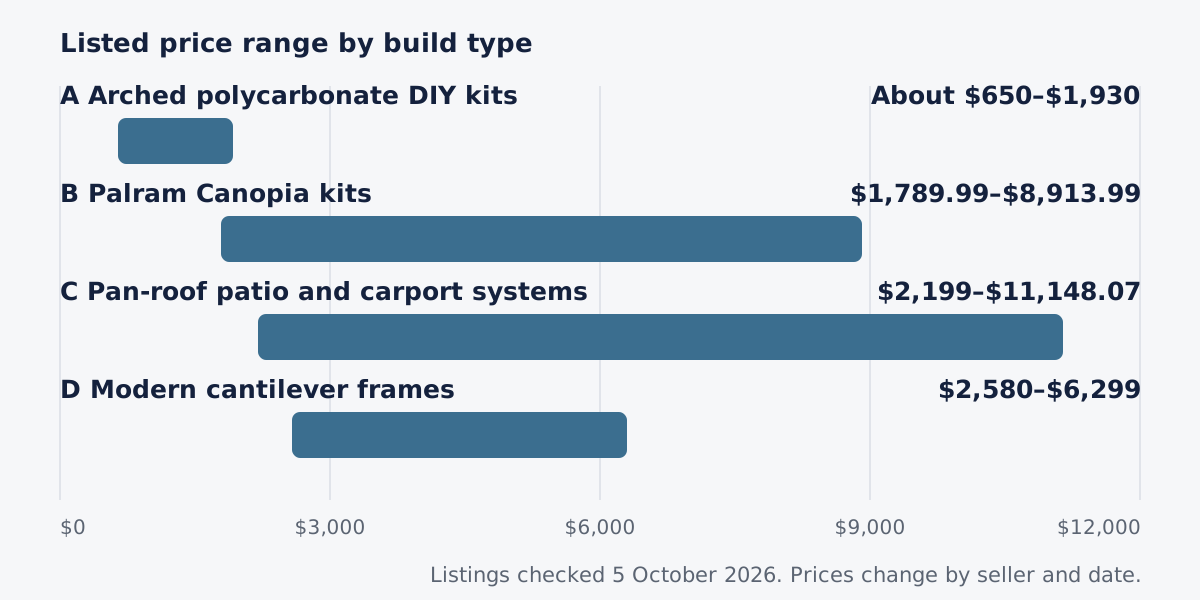
Listings checked on 5 October 2026 ran from about $650 for arched polycarbonate DIY kits to $11,148.07 for pan-roof systems, in four build types. Each band comes from named sellers on one date, and no band is averaged or blended.
Prices move by seller. The Palram Arizona Wave 5000 was listed at $1,789.99, $2,987.47, $4,469.00 and $5,185.00 across four listings from three sellers on 5 October 2026, so compare the seller, the date and what is included. Kit listings are compared on the carport kits page.
| Build type | Range | Examples seen | Date |
|---|---|---|---|
| A Arched polycarbonate DIY kits | About $650–$1,930 | amerlife $649.64; JUJABU $1,085.99; Mondawe $1,527; CARBUTLER $1,925.99 | 5 Oct 2026 |
| B Palram Canopia kits | $1,789.99–$8,913.99 | Arizona Wave 10x16 $1,789.99 to $5,185.00 (four listings); Vitoria $1,990.99; Colorado $2,969.57 to $7,499.99; Arizona 19x16 double $8,913.99 | 5 Oct 2026 |
| C Pan-roof patio and carport systems | $2,199–$11,148.07 | Florida Aluminum Systems 10x14 $2,199 (listed as sold out); ScreenHouse range from $4,432.42 to $11,148.07 | 5 Oct 2026 |
| D Modern cantilever frames | $2,580–$6,299 | Ready Canopy "from" prices: L-shape single $2,580; minimalist full-aluminum single $3,599; back-pull double $6,299 | 5 Oct 2026 |
| Cost guide: aluminum, per sq ft | $5–$15 materials; $8–$20 installed | HomeGuide, updated 16 January 2026. Steel: $5–$10 materials; $8–$15 installed | 16 Jan 2026 |
| Cost guide: metal carports by size | 12x20 $2,000–$4,800; 20x20 $3,200–$8,000 | HomeGuide, updated 16 January 2026 | 16 Jan 2026 |
HomeGuide, updated 16 January 2026, puts aluminum at $5 to $15 per sq ft for materials and $8 to $20 per sq ft installed, against $5 to $10 and $8 to $15 for steel. Its metal carport table gives $2,000 to $4,800 for a 12x20 and $3,200 to $8,000 for a 20x20. For the 20x20 footprint, see 20x20 carport size.
Tariffs on metal can move prices (Eagle Carports, modified 25 September 2025). Check what each price includes: kit only or installed, roof panels, anchors and delivery.
Where does an aluminum carport fit?
An aluminum carport suits buyers who want a light frame that does not rust, and who will check the five items above. Arizona Pergola, a patio-cover seller, lists heat, rain noise and dents as the drawbacks of aluminum carport covers (Arizona Pergola, checked 5 October 2026).
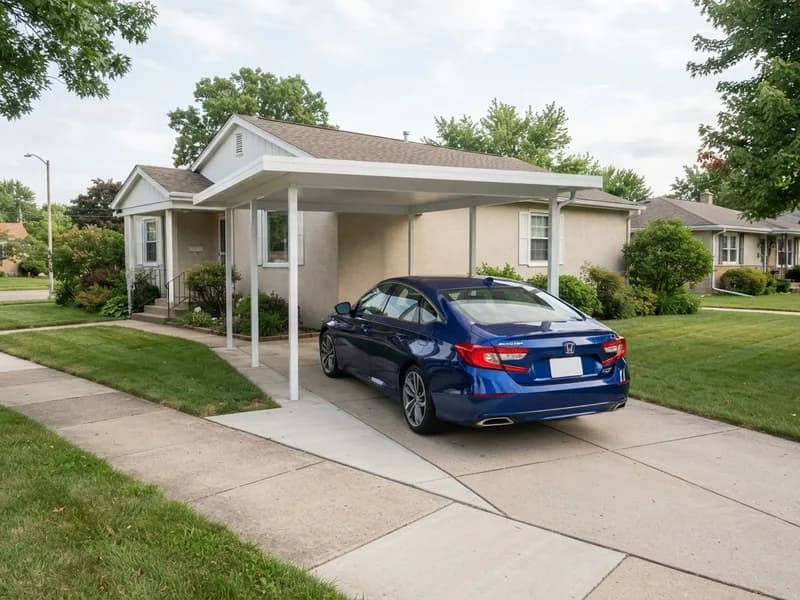
A freestanding carport stands on its own posts, and an attached one shares the house wall and roof edge. Attached, enclosed and kit versions follow the same five checks. For two vehicles, see the 2 car carport page.
Does an aluminum carport need a permit?
IRC 2021 section R105.2 exempts one-story detached accessory structures of 200 sq ft or less from a building permit, and the local building department decides the rest. States and cities adopt and amend the code, so confirm the code edition and the exemption size with the building department before ordering. The carport permit rules page covers the baseline figures.
What should you ask before you buy?
Six questions to put to the seller before ordering: wind rating and basis, snow load, alloy and temper, wall thickness, fastener metals, and the price date.
- What is the wind rating, is it ultimate or nominal, and which standard was it tested to?
- What snow or live load in psf does it carry, and under which code edition?
- Which alloy and temper is the frame?
- How thick are the walls, in decimal inches or millimeters?
- What are the fasteners made of, and are the joints isolated?
- What date is the price, and what does it include?
Share your ZIP code and project details to be matched with installers and manufacturers that serve your area.
Questions about aluminum carports
Listings checked on 5 October 2026 ran from about $650 for DIY kits to $11,148.07 for pan-roof systems. HomeGuide (updated 16 January 2026) gives $8 to $20 per sq ft installed. These are published prices, not quotes.
Not by stiffness: aluminum is about one-third as stiff as steel, 70 against 200 GPa. Strength depends on the alloy, temper and section, so ask the seller for all three.
No, aluminum has no iron to rust. It can corrode in coastal air and where steel fasteners touch it in a wet joint, so ask what the fasteners are made of.
A rating is only useful with its speed, basis and standard, set against the design wind speed at your address. Inland Texas uses 90 mph under ASCE 7-16, for example. Your building department confirms yours.
Yes. Aluminum is the US and Canadian spelling and aluminium is used elsewhere. Both words, and the shorthand alu, describe the same frame metal.
Not by HomeGuide's January 2026 ranges: aluminum is $5 to $15 per sq ft for materials against $5 to $10 for steel. Prices vary by build type and seller.
Last verified:
Ready to move forward
Get Matched With Installers Near You
Tell us a bit about your project and we will connect you with vetted installers and manufacturers who serve your area. There is no cost or obligation to request information.
See the affiliate disclosure page for how referrals work.